How do I work out what to charge as a creative freelancer?
Asking around tells you what others charge. Here's how to work out what you need to charge, how to price a project with supplier costs inside it, and how to tell when your rate is still too low.

Short answer
Work backwards from what you need to earn. Add your income target, your business costs and a tax set-aside, then divide by the hours you can realistically bill in a year: that's your floor rate. Price each project from the hours and supplier costs inside it, then check it against what others charge. If your price feels comfortable, it's probably too low.
When I started freelancing, I set my rates the way most people do: I asked around and found out what others were charging. It’s not a bad place to start. But every time I’ve realised my rates were wrong since then, they’ve been too low, and I’ve usually found out by comparing notes with someone doing similar work for more.
Asking around tells you where the market is. It can’t tell you what you need to charge, because nobody else knows your costs, your hours or what you need to take home. That number you have to work out yourself, and it’s simpler than it sounds.
Step 1: find your floor rate
Your floor rate is the lowest hourly rate at which your business still pays you properly. Below it, you’re working for less than you need. It comes from four numbers:
- What you want to take home in a year.
- What the business costs to run: software, equipment, insurance, your accountant, your share of rent and data.
- What to set aside for tax. Ask your accountant for your own figure; the example below uses 25% purely to show the sum.
- How many hours you can actually bill. Not the hours you work: the hours a client pays for. Admin, quoting, chasing and finding the next job all eat into the week.
The same sum works in any currency. What matters is that you do it with your own numbers, not someone else’s.
Step 2: price the project, built from hours
Whether I quote by the hour, the day or the project depends on the job and the relationship. But even a project price is rooted in hours. Clients buy outcomes, so I quote outcomes, and I build the number underneath from time:
- Estimate the hours honestly, including meetings, revisions and file prep, then multiply by a rate at or above your floor.
- Add a contingency of 10–20% for the revision round nobody planned. Better still, write the number of revision rounds into the agreement; it’s where most projects overrun.
- Add every supplier cost separately: illustration or photography you’re commissioning, developers, printing, fonts, stock. Many studios add a handling fee on top, because managing a supplier is work too.
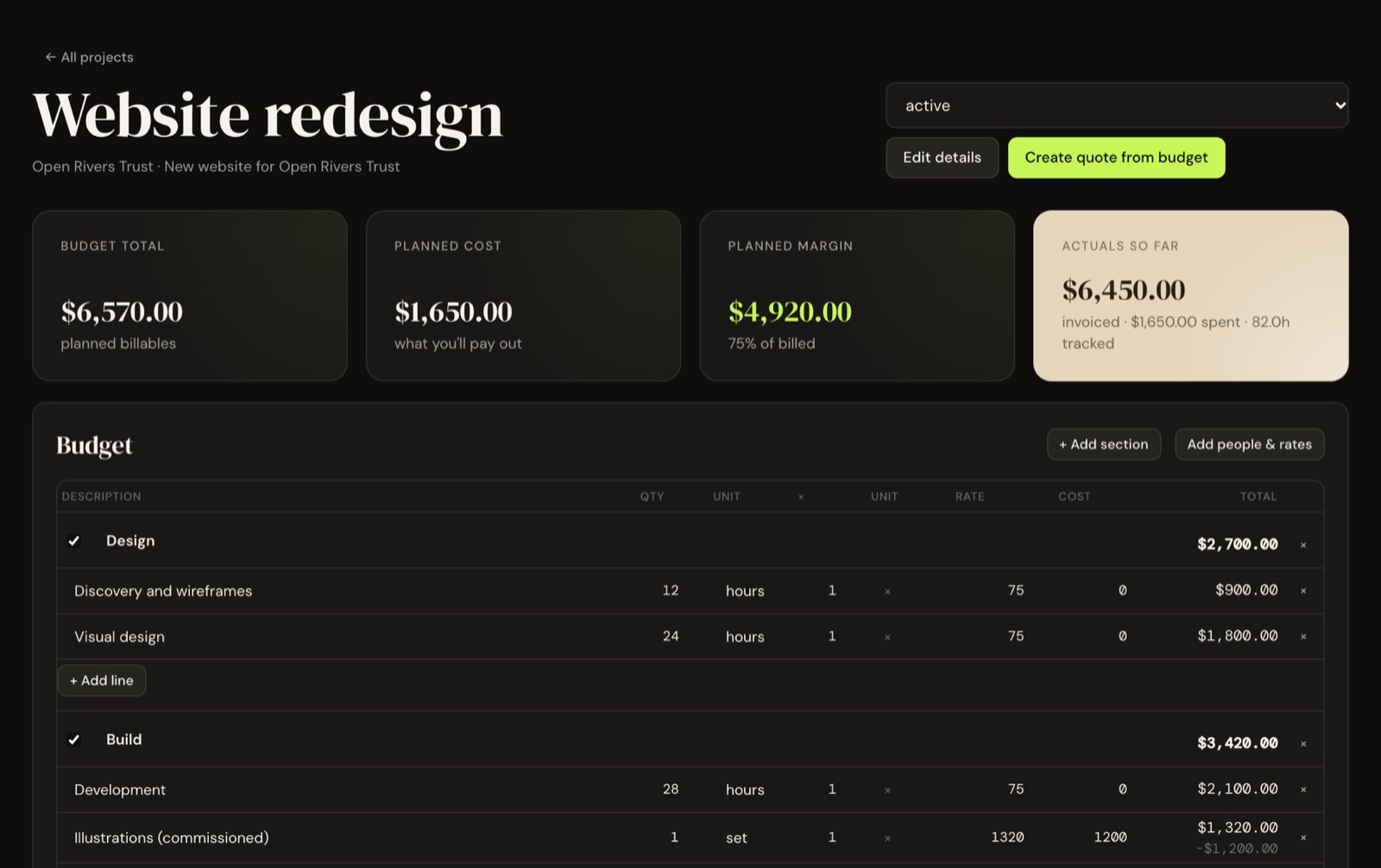
This is the gap most pricing advice skips. Creative projects often have real money flowing through them to other people. If you price your fee correctly but absorb a supplier cost, or misread a supplier’s quote, the job can quietly lose money. I’ve done exactly that, which is in how to know if a project actually made you money.
Step 3: check it, and check how it feels
Now go back to asking around. If your project price lands where people doing comparable work land, you’re in the right place. If it’s well above, ask whether the scope is bigger than the client expects, rather than cutting your rate. If it’s well below your floor, the job is too small at that price: say so, or say no.
Then there’s the test no spreadsheet gives you.
A good price is one where both parties feel a bit uncomfortable. If your rate feels too comfortable, it’s too low.
I think you should feel slightly uncomfortable saying your number out loud. If you don’t, you’ve almost certainly priced for the client’s comfort rather than for your business.
The short version
Your floor rate is a fact about your business, not an opinion about your talent. Work it out once a year, build project prices from hours, put supplier costs on their own lines, compare notes with your peers, and if the number feels easy to say, raise it.
Questions people also ask
Should I charge by the hour or by the project?
It depends on the project and the relationship, and many freelancers use both. Either way, even a project price is rooted in hours: estimate them honestly and multiply by a rate at or above your floor before you round to a project figure.
How do I know if my rates are too low?
Compare notes with people doing similar work, and notice how you feel when you say the number. If it feels completely comfortable, it's probably too low. A good price leaves both you and the client feeling slightly uncomfortable.
How often should I raise my rates?
Review them every year, and whenever your costs jump or you're consistently fully booked. A full calendar is the clearest sign your price is too low.
Should I show my hourly rate on the quote?
Usually not. Quote the deliverables and a project price. Showing hours invites the client to negotiate the hours instead of the outcome.