Should I ask clients for a deposit, and how much?
Why a deposit protects your time and your cash flow, how much to ask for, and how to ask without it feeling awkward

Short answer
Yes. Ask for 50% before you start, and add any supplier costs you'll pay upfront, like stock imagery or a subcontractor. A deposit confirms the client is serious, covers your out-of-pocket costs, and means you're never funding someone else's project while you wait out their payment terms. If a client can't afford a deposit, they can't afford to pay you.
Early in my career I started a website project without a deposit. When it was done, the client said he wasn’t happy with the result, didn’t pay, and walked away. I don’t remember the exact figure, but in today’s money it would be around R100,000 of work. I had nothing to show for it except the lesson, and I’ve asked for a deposit ever since.
A deposit is the simplest protection a freelancer has, and the one we’re most shy about asking for. It feels like asking a new client to prove they trust you. In practice it works the other way round: it shows them you run a business, and it shows you they’re serious.
If a client can’t afford a deposit, they can’t afford to pay you.
Why a deposit matters
Without one, you’re the bank. Most organisations pay on 30-day terms, some on 60, and those terms usually start counting from your final invoice, not the day you start work. A six-week project followed by 30-day terms means two and a half months of your time before any money arrives, and longer still if the invoice sits in an approval queue.
In the meantime you’ve paid your rent, your software and possibly your suppliers. That isn’t a client relationship. It’s an interest-free loan.
How much to ask for
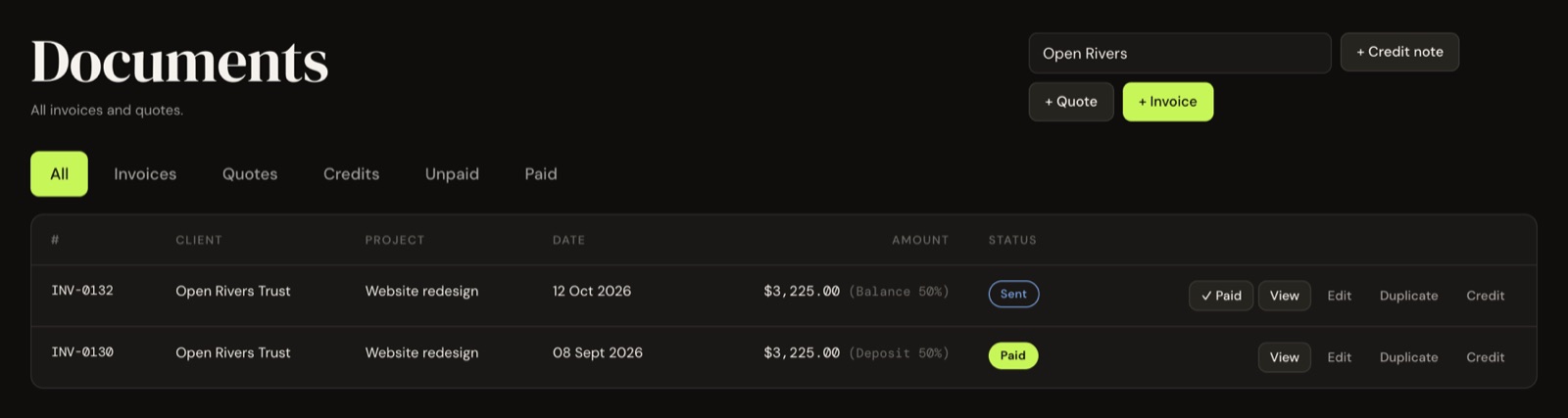
I ask for 50%. It’s enough to cover the work up to the halfway point, so if a project goes wrong you’ve been paid for what you did. As a general guide:
- 50% for new clients, fixed-price projects and anything with a tight deadline.
- 30% as a floor for clients you know, if 50% is a sticking point.
- Staged payments for projects longer than about six weeks, such as 40% to start, 30% at an agreed midpoint and 30% on delivery.
If the job has supplier costs inside it, like stock imagery, a subcontractor or software you’re licensing for the client, add them on top. Never fund a client’s costs from your own account.
When I skip it
With long-standing clients, where there’s a good, trusting relationship and the project is small, I often don’t ask for a deposit. The risk is low and the relationship matters more.
On bigger projects I ask even when I trust the client completely, because at that point it isn’t about trust. It’s about cash flow: a large project without a deposit means carrying weeks of unpaid work, however good the client is.
When the client is a large organisation
In my experience, the only real pushback comes from larger organisations whose finance teams work on fixed 30-day terms. I always try to push through that and get paid sooner. Sometimes it works. Sometimes it’s simply part of working with larger organisations, and you factor it in.
If their process genuinely can’t pay upfront, ask for the deposit invoice to be raised the day the contract is signed. Their 30 days then start at the beginning of the project, so the money arrives a month in rather than a month after you’ve finished.
How to ask without it being awkward
Don’t ask. State it. A deposit lands badly when it arrives as a surprise after the client has already said yes. It lands well when it’s written into the quote from the start, as plain fact:
To book the project in, a 50% deposit of $3,450 is due on acceptance. Work starts the day it clears, and the balance is due on delivery.
Put the same line in your agreement, and send the deposit invoice the day they accept. Speed matters: the moment of “yes” is when a client is most willing to pay.
What to do when the deposit arrives
Record it against the job, not just in your bank statement. When the balance invoice goes out weeks later, you want the deposit to show as paid, so the client sees one clear amount still due. If you’re working from a spreadsheet, this is exactly where things slip.
Questions people also ask
How much deposit should a photographer ask for?
Most photographers ask for 30–50% to secure the date, because a booked day is a day they can't sell to anyone else. For weddings and events, 50% is common, with the balance due before the shoot rather than after.
Is a deposit refundable if the client cancels?
Only if your agreement says so. Write it down before work starts: many creatives make the deposit non-refundable once work has begun, because it pays for time already spent and work already turned away.
What if a client refuses to pay a deposit?
Treat it as information. If a client can't afford a deposit, they can't afford to pay you. Offer a smaller first stage instead, such as a paid discovery phase, rather than starting the whole project on trust.
What if a large organisation's payment terms don't allow deposits?
Ask anyway, and if their process can't move, ask for the deposit invoice to be raised the day the contract is signed. Their 30 days then start at the beginning of the project, not at the end.